
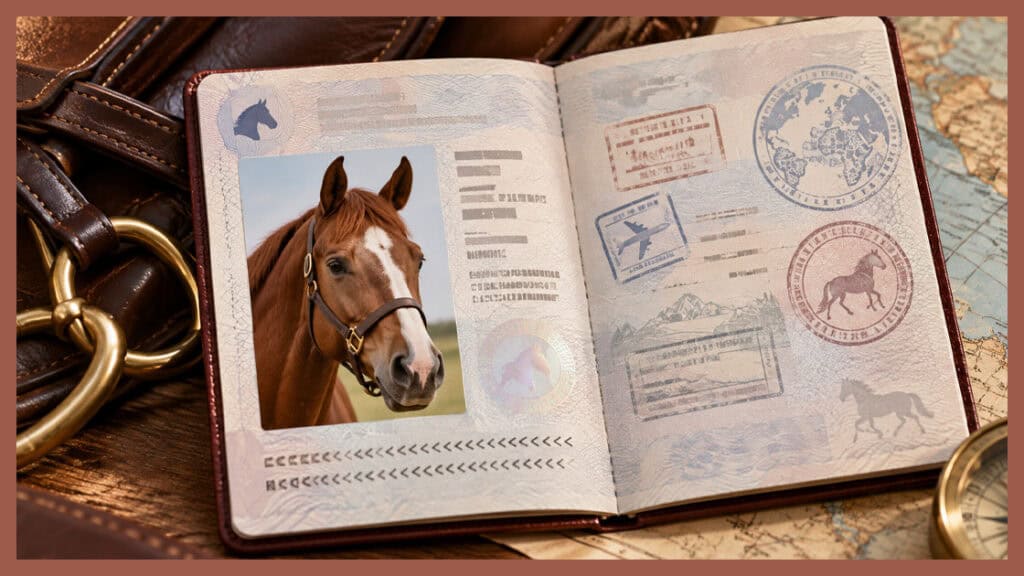

Horse passport fraud has returned to the headlines, and it is a reminder that food fraud continues to evolve. This case shows why food document fraud and frontline inspection deserve a place in every vulnerability assessment. Make sure food documents are considered in your food fraud vulnerability assessment.
This news alert was forwarded to me by my close colleague (and mentor on many topics), Dr. John Keogh. On September 10, 2026, Europol announced an operation against a criminal network suspected of trafficking horses across Europe using falsified documents and manipulated microchips [1]. Once again, there is another horsemeat fraud concern based on the concept of horse passports.
A Europe-Wide Operation on Horse Identity Fraud
Between September 8 and 9, 2026, nearly 200 officers took part in a Belgium-led operation. They carried out 24 searches across Belgium, France, Ireland, and the Netherlands and checked more than 1,000 horses. In the Europol news release, they state that investigators suspect “forged horse passports and manipulated microchips were used to effectively give animals new identities.” This allowed the suspects to hide each horse’s origin, history, and “whether they were eligible to enter the food chain.”
The concern is twofold. Some horses may have been resold under false identities with no veterinary history, while others may have been illegally diverted from working animals and into the food chain (remember, in many regions of the world, horse meat is a legitimate human food). Europol noted that this undermines the traceability systems that protect both animal welfare and food safety. The investigation remains ongoing.
Horse Passports as Food Documents
In the European Union, a horse passport is a single lifetime identification document that must accompany the animal during all movements [2]. The system links the document to the animal through a transponder (microchip) or an alternative method such as a DNA profile. The identification details are recorded in the databases of the issuing bodies and in a central database. The current rules are set out in Regulation (EU) 2016/429, Delegated Regulation (EU) 2019/2035, and Commission Implementing Regulation (EU) 2021/963 [3].
This is food document fraud. The passport is the record that establishes whether a horse may enter the food chain. When the passport and the microchip are both manipulated, the document and the animal appear to match, so routine checks may not reveal the problem.
This is not a new vulnerability. In 2017, the Spanish Guardia Civil (Spanish federal police), in coordination with Europol, dismantled a network that forged horse identities by modifying microchips and documentation, with 66 arrests [4]. In 2022, a Europol-supported investigation in Spain and Belgium led to 41 arrests for falsifying horse transfer and identification documents [5]. During the 2019–2020 Operation OPSON IX, about 20% of the foreign horse passports checked reportedly showed signs of forgery [6].
Persistence and Diligence: The Role of Operation OPSON
Because of the suspected link to the food chain, Europol brought in expertise from Operation OPSON. OPSON is a joint Europol–INTERPOL operation targeting fake and substandard food and beverages [7]. It has run since November 2011, is coordinated by the Intellectual Property Crime Coordinated Coalition (IPC3), and involves partners across Europe and beyond, including the United States.
The value of OPSON is its persistence and diligence. Food fraud is not resolved in a single action day. It is controlled over time through repeated, coordinated work among law enforcement, regulators, academics, and industry.
. . . . . . . . . .
Sidebar: Previous Food Fraud Prevention Academy Interaction with Operation Opson:
- Review of INTERPOL / EUROPOL Operation OPSON IX Final Report (global food fraud investigations), January 11, 2022, https://blog.foodfraudpreventionthinktank.com/review-of-interpol-europol-operation-opson-ix-final-report-global-food-fraud-investigations/
- ANNOUNCEMENT – Primer on Food Fraud Suspicious Activity Report (FFSAR) Tool, October 24, 2023, https://blog.foodfraudpreventionthinktank.com/announcement-primer-on-food-fraud-suspicious-activity-report-ffsar-tool/
- The Danger of Simulations and the Case of Petrus Lambertini vs. Chateau Petrus, November 15, 2022, https://blog.foodfraudpreventionthinktank.com/the-danger-of-simulations-and-the-case-of-petrus-lambertini-vs-chateau-petrus/
. . . . . . . . . .
This Europol operation shows that horse passport fraud remains an active food document fraud concern and that Operation OPSON continues to support the response.
. . . . . . . . . .
Takeaway Points
- Food fraud is not “solved” but “controlled.” It is more like managing diabetes than fixing a broken leg.
- Horse passport fraud shows how food document fraud can make an ineligible animal appear eligible to enter the food chain.
- Include food document fraud in your vulnerability assessment, and support multidisciplinary efforts such as Operation OPSON.
. . . . . . . . . .
For more information:
- Primer on Food Document Fraud: https://foodfraudpreventionthinktank.com/wp-content/uploads/2025/12/FFPTT-Primer-Food-Document-Fraud-FDF-v6.pdf
- New “Food Fraud 20 Questions” Survey: Food Document Fraud – Concerns and Countermeasures, February 15, 2022, https://blog.foodfraudpreventionthinktank.com/new-food-fraud-20-questions-survey-food-document-fraud-concerns-and-countermeasures/
- Food Fraud Prevention Meets Supply Chain Digitalization: Why Old Systems are Not Enough: The intersection of digitalization, omnichannel operations, and automation is creating both challenges and opportunities for food fraud prevention, By John W. Spink Ph.D., Roy Fenoff Ph.D., Food Safety Magazine, May 13, 2026, https://www.food-safety.com/articles/11424-food-fraud-prevention-meets-supply-chain-digitalization-why-old-systems-are-not-enough
References:
[1] Europol, European Union Agency for Law Enforcement Cooperation (2026). Thousands of horses caught up in Europe-wide trafficking scheme, September 10, 2026 [Accessed September 26, 2026], https://www.europol.europa.eu/media-press/newsroom/news/thousands-of-horses-caught-in-europe-wide-trafficking-scheme
[2] European Commission, Directorate-General for Health and Food Safety. Equine animals [Accessed September 26, 2026], https://food.ec.europa.eu/animals/identification/equine-animals_en
[3] Commission Implementing Regulation (EU) 2021/963 of 10 June 2021 on the identification and registration of equine animals, https://eur-lex.europa.eu/eli/reg_impl/2021/963/oj
[4] Europol (2017). Police dismantle crime group trading horsemeat unfit for human consumption, July 16, 2017 [Accessed September 26, 2026], https://www.europol.europa.eu/media-press/newsroom/news/police-dismantle-crime-group-trading-horsemeat-unfit-for-human-consumption
[5] Europol (2022). 41 arrests for selling potentially dangerous horse meat [Accessed September 26, 2026], https://www.europol.europa.eu/media-press/newsroom/news/41-arrests-for-selling-potentially-dangerous-horse-meat
[6] Eurogroup for Animals. New Europol investigations reveal horse meat fraud, raising public health and animal welfare concerns [Accessed September 26, 2026], https://www.eurogroupforanimals.org/news/new-europol-investigations-reveal-horse-meat-fraud-raising-public-health-and-animal-welfare
[7] Europol. Operation OPSON [Accessed September 26, 2026], https://www.europol.europa.eu/how-we-work/operations/operation-opson
Artificial Intelligence (AI) Use Explanation: The idea and conceptual design were generated by the author based on previous experience and ongoing research. Project support was provided by ChatGPT, Claude.ai, Nano Banana, Grammarly, and EndNote. All AI-assisted content was reviewed, verified, edited, and approved by the author, who takes full responsibility for the accuracy and integrity of the final manuscript. No AI tool is credited as an author.